

Alcohol Addiction - Recognizing the Signs and Seeking Help
You’re Not Alone and Things Will Get Better
Perhaps there have been a few more nights than you would like where the drinking has felt out of control, or maybe someone you love is disappearing into a fog and you just can’t tell how long they can keep the act up. The reality is, that most people go through alcohol addiction, and it does not always reveal itself in the forms we expect. In fact, for a lot of people, it is the quiet, self-isolating moments that define the ordeal.
So whether you are the one suffering, or whether it is someone you love who is sinking deeper into the abyss, the good news is that you are not alone. Feeling puzzled, afraid, and even angry is all perfectly fine. Understanding the alcohol addiction signs can be challenging, yet is the first step to seeking the help you need. In this scenario, seeking help with alcohol addiction, whilst frightening, is the first step towards healing.
Alcohol Addiction and Its Impacts – The Unseen Effect
At the centre of alcohol addiction is not the inability to “hold your liquor” or excessive partying. Alcohol addiction stands around dependence; physical, emotional, or mental. It is the way alcohol begins to permeate various facets of your life without your notice. It may start as drinking to feel better, a teacher’s favourite, or simply trying to conform. As time passes, what used to be innocent turns into something you depend on, and eventually, you reach a stage when you feel like you can’t function without it.
In most cases, alcohol dependence symptoms are subtle or, even worse, neglected by everyone, including the individual suffering. Alcoholism symptoms does not always manifest itself in the form we have come to expect, someone dead drunk and disorderly, coming out from bars or creating a scene. More often than not, it is simply the unquenchable thirst from a long day’s work, telling yourself this is the last time you are having a drink tonight or exuberant panic before a social gathering in the absence of alcohol.
The mental conflicts are not always obvious, and that is what makes them most sneaky. However identifying the issues that emanate from alcohol abuse is the turning point to taking control of your life or aiding a person who is close to you in doing so.
Common Signs of Alcoholism – When the Lines Start to Blur
If you are wondering whether you or someone close to you is struggling with an alcohol problem, it is usually the tiny tips that start accumulating and pointing towards an issue. Below are some signs to look out for:
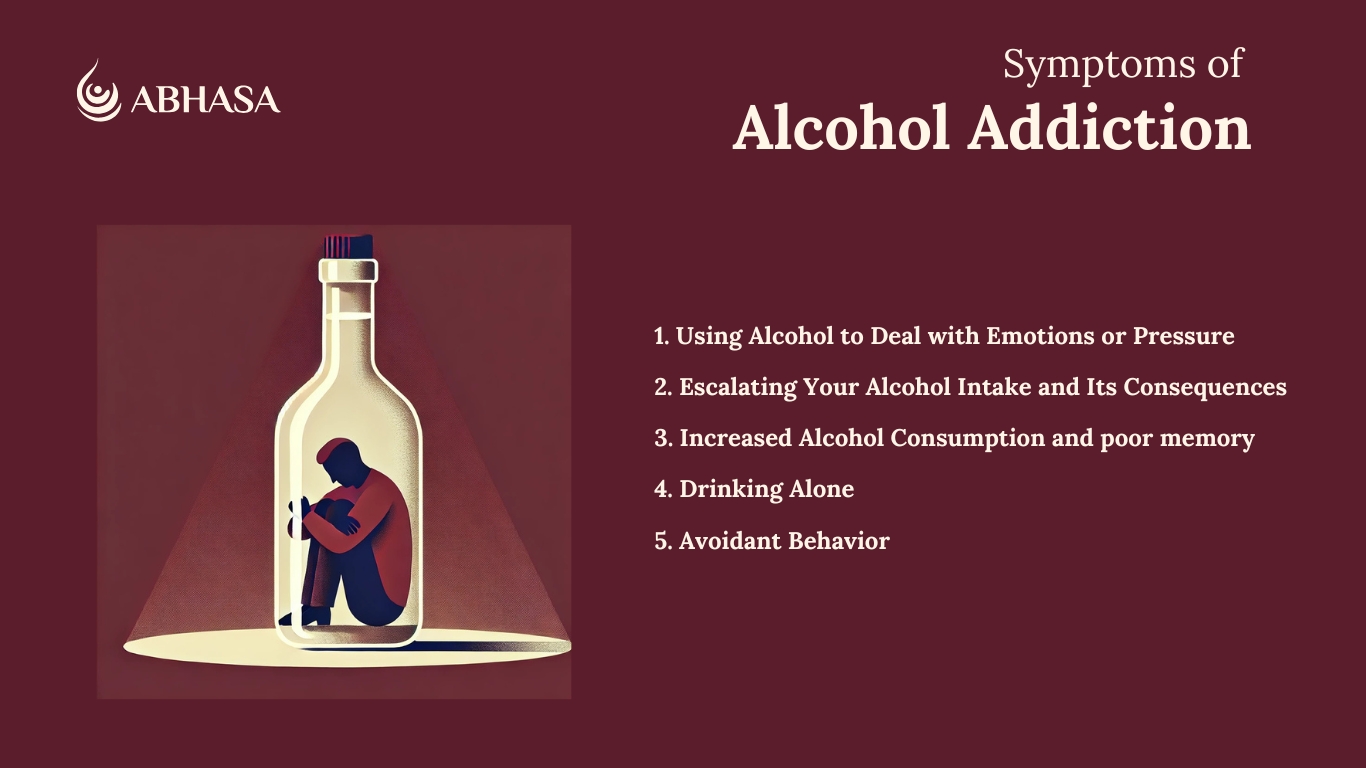
1. Using Alcohol to Deal with Emotions or Pressure
This has been identified as one of the most common methods of misusing alcohol. A busy life filled with challenges such as work-related stress, relationship troubles, and family issues can easily lure a person to use alcohol as a shortcut to relief. Unfortunately, when alcohol becomes the escape route, there begins reliance on it. Ultimately, you will reach a stage where that initial relief turns into a vicious cycle, and drinking more becomes the only way to feel better.
2. Escalating Your Alcohol Intake and Its Consequences
At first glance, a couple of drinks may seem like a good escape, however, it doesn’t take long to realize that in order to feel the same ‘buzz’, you would need progressively more. You may wish to have only one or two drinks, but when it’s all said and done the bottle is empty and you are questioning your actions. This endless cycle is dangerous and indicative that symptoms of alcoholism are starting to take root.
3. Increased Alcohol Consumption and its Effects on Your Memory
Do you remember waking up and searching for your memories, only to realize there is nothing to recollect? This empty feeling can be one of the signs of alcohol addiction. After consuming excessive quantities of alcohol, our brain has no control over the functions we perform and time passes without us being aware of it. In case you have noticed gaps in your memory or if you have been informed by others of acts done by you not remembered, then the best course of action would be to take a step back.
4. Drinking Alone
Once you begin to conceal your alcohol use or prefer to drink alone, there is a strong possibility that there is something deeper at stake. What seems like social drinking can easily transition to drinking alone; the presence of others is no longer required to drink. The need to consume alcohol begins to replace feelings and sentiments when the world is too much to handle or during moments when one just longs to “escape” from their emotions.
5. Avoidant Behavior
Missing work, avoiding family responsibilities, and other activities that require active attention due to the consumption of alcohol are perhaps some of the most concerning signs. It is a red flag. Alcohol is taking control. Almost all other previously mentioned activities are set in a dormant state. Neglecting activities over time deteriorates the quality of life, be it through a broken relationship, loss of a job, or a serious health problem.
How to Search for Alcohol addiction help – Stopping Alcoholism and Taking Control of Your Life
Identifying an alcohol problem for yourself or a loved one can be quite daunting, but with fear comes the motivation to take the first step. The most important step in overcoming an addiction is accepting that there is a problem in the first place. Seeking treatment is not a cry for help, it is a brave decision to let go of health troubles, bad relationships, and any self-destructive behaviour that has been in control for so long.
1. Communicating with someone you have confidence in.
Sharing the personal challenges that you face can be very uncomfortable, but it’s usually the first step towards recovery. A friend, family member, or even an expert can help in discussing alcohol abuse warning signs and assist you to start overcoming the addiction. If, on the other hand, you are assisting somebody, what is most important is your support which must be non-judgmental. Sometimes a person only needs to be told that there is no need for them to tackle this problem alone in order for them to make the change.
2. Looking for professional help – Treatment and therapy.
Treatment of alcohol addiction in different people can take many forms, with each case having its distinct features and level of severity. A common treatment option is therapy, especially Cognitive Behavioral Therapy (CBT), which seeks to correct the underlying thought processes that are contributing to the addiction. Additionally, many people benefit from alcohol addiction support groups as they are able to speak to people who are at the same stage of their journey. Such groups offer a chance to not only talk but also listen and know that one does not have to fight this problem alone.
3. Detox and Rehab – Starting Fresh
In the event of more severe cases of alcohol addiction, there may be a need for some form of detox treatment or a stay at a rehab centre. These programs give the opportunity to break free from the physical dependence of alcohol in a more monitored environment. While it may not be easy, it serves as the first step of getting to freedom. In detox, one focuses on clearing the substance from the body, whereas rehab is focused on the deeper work needed, the emotional and mental healing work that allows for the rebuilding of one’s life.
4. Building a Support Network
The road to recovery from addiction is not a solitary path. To overcome alcoholism, one must have a supporting solid foundation to stand upon and remain motivated. This can be a sponsor in an Alcoholics Anonymous (AA) group, a therapist, or even family members who care and are willing to partake in this journey. People who appreciate and want the best for you can help make that difference.
Help Is Always Available
If any part of what was said resonates with you or someone you care about, seeking assistance does not represent weakness, it marks the beginning of a journey towards empowerment. Identifying as an alcoholic does not have to be your reality, and there is freedom, the first step is understanding what the signs of alcohol addiction are, and having the strength to seek help. At Abhasa we carefully curate modalities that support recovery and help regain life.
Recovery is always possible so long as there is a willingness to engage in therapy, rehab, or join an alcohol addiction support group. People often feel discouraged in their healing journey due to the length of time it might take, but it’s important to remember that every step is one step closer to achieving true self-identification. Know now that there’s more than enough succour available for you at all times, the clock is always running when it comes to when you choose to begin. Choose to start now and know that a sober life fulfilling all your desires is achievable, it’s just waiting for you.